


Discovering Poppi Castle
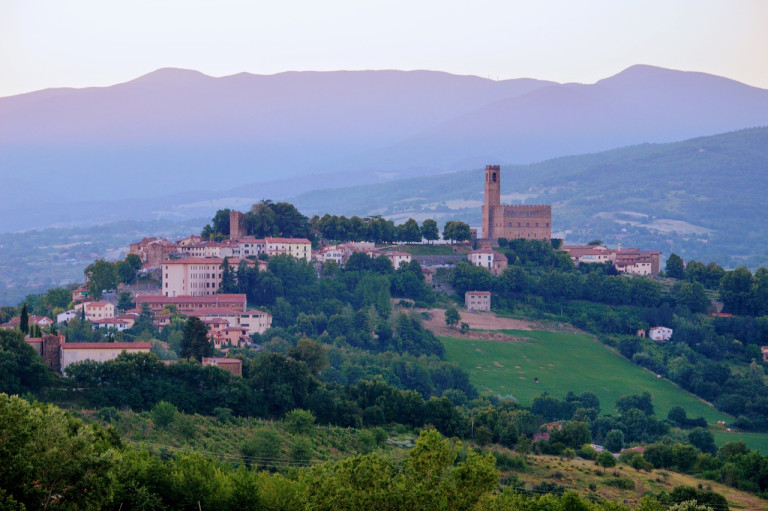
Poppi Castle, perched on a hill overlooking the Casentino valley, is one of the most remarkable historical jewels of eastern Tuscany. Built between the end of the 12th and the beginning of the 14th century by the prestigious Guidi family, the castle stands out for its majesty and exceptional architectural preservation. The imposing tower and sturdy walls tell of a medieval past that has come down to us without being seriously altered. Today,
Poppi Castle continues to be the fulcrum of the town’s administrative life, housing the Poppi Municipality. Its strategic position and the intact beauty of its structures make it a symbol of the history and culture of the Casentino, which can be admired from many parts of the valley and is often immortalised in evocative panoramic views that vary with the changing seasons and light.
The Origins and History of Poppi Castle
The history of Poppi Castle is deeply linked to the powerful Guidi family, one of the most influential families in Tuscany and Romagna. Although the first written mention dates back to 1191, the castle’s origins may be older, probably dating back to the time of the Longobard and Frankish invasions. This castle has always played a key role as the seat of local power, thus ensuring its preservation through the centuries.
The square tower, the original element of the structure, continues to dominate the Casentino valley. The Guidi made Poppi the nerve centre of their property, residing in the castle for almost four hundred years. During this period, the castle underwent numerous renovations and extensions, evolving from a simple fortress to a noble residence. The castle was also the stage for significant historical events, such as the surrender of Francesco Guidi to the Florentine Republic in 1440.
Architecture of Poppi Castle
The architecture of Poppi Castle is a fascinating example of medieval evolution, combining defensive elements with residential aspects. In the heart of the castle is the square tower, tall and imposing, originally conceived as a defensive and sighting structure. Over time, starting in 1274, Count Simone Guidi initiated a series of extensions that transformed the fortress into a noble residence.
The castle has an asymmetrical structure, with later additions including the rectangular keep and the wing opposite the tower. An amazing stone staircase, built in the 15th century, connects the various floors of the castle, lending elegance to the inner courtyard. The façade, decorated with double lancet windows and noble coats of arms, reflects the influence of architects Lapo di Cambio and Arnolfo di Cambio, although there is no documentary evidence to support this. The tower served as a model for Palazzo Vecchio in Florence.
Significant historical events: the Battle of Campaldino
Poppi Castle was the scene of important historical events, including the famous Battle of Campaldino, which took place on 11 June 1289. This crucial clash between the Guelph forces of Florence and the Ghibelline forces of Arezzo took place on the plains near the castle, under the imposing gaze of its walls. The Guelph victory consolidated Florence’s power in the region, marking a turning point in Tuscan history.
Moreover, in 1440, the castle was the site of the surrender of the last Guidi count, Francesco, to the Florentine Republic, marking the end of the Guidi family’s rule in the Casentino. These historical events not only shaped the history of the valley, but also left a lasting imprint on Poppi Castle. Today, the memory of these battles is kept alive in the castle, which houses a museum dedicated to the Battle of Campaldino.
The role of Poppi Castle as residence and administrative seat
Poppi Castle has played a crucial role in the political and administrative life of Casentino since its origins. Initially the aristocratic residence of the Guidi counts, the castle was gradually transformed from a simple fortress into a luxurious noble palace. The robustness of its structure and constant maintenance have allowed the castle to maintain its magnificence through the centuries.
This continuous use has preserved the castle from the degradation that has affected many other medieval structures. Its rooms, once the scene of banquets and noble gatherings, now host institutional meetings, conferences and cultural events, keeping alive the link between the glorious past and the contemporary life of Casentino.
Dante Alighieri and the link with Poppi Castle
One of the most fascinating aspects of the history of Poppi Castle is its link with Dante Alighieri. During his exile from Florence in 1310, Dante was a guest of Count Guido di Simone da Battifolle, residing in the castle for about a year. It is said that it was within these ancient walls that Dante wrote part of the XXXIII canto of the Inferno of the Divine Comedy.
Dante’s stay at Poppi Castle underlines not only the importance of the manor as a refuge and cultural centre, but also its role in the intellectual life of the time. A bust of Dante, placed in the square in front of the castle, celebrates this historical link, reminding visitors of the illustrious guest who stayed there. This episode further enriches the historical and cultural value of the castle, making it a symbol of Casentino.
Restoration and conservation of Poppi Castle
The Poppi Castle has benefited from numerous restoration works that have preserved its integrity and beauty. Among the most significant was the restoration in the 19th century, when the tower was damaged by lightning. During this intervention, the tower was converted into a bell tower, reducing its height and adding a belfry in place of the crown of Ghibelline merlons.
Subsequent restoration work in the 20th century affected the battlements, mullioned windows and other parts of the masonry, restoring the castle to its original medieval appearance. These interventions not only repaired the damage caused by time, but also enhanced the architectural and artistic elements of the castle. The care devoted to the conservation of the castle makes it an exceptional example of historical heritage protection. Thanks to these restorations, Poppi Castle continues to be a cultural and tourist landmark, attracting visitors from all over the world.
The charm of the Casentino Valley and the village of Poppi
Situated not far from Arezzo and the B&B Antiche Mura, the Casentino valley is a fascinating area to explore. Surrounded by lush forests, green hills and crossed by the Arno river, this Tuscan region is a concentration of history, nature and architectural beauty. At the centre of this enchanting landscape is the village of Poppi, dominated by its imposing castle.
Visiting Poppi – one of Italy’s most amazing burghs – means taking a plunge into the past, into a beautifully preserved medieval atmosphere, where every street and square tells stories of nobility, battles and illustrious personalities such as Dante Alighieri. The village, with its cobbled streets, ancient churches and charming little squares, offers visitors an authentic and engaging experience. Exploring Poppi Castle and the surrounding village is an unmissable journey that offers total immersion in the history and beauty of the Casentino.