
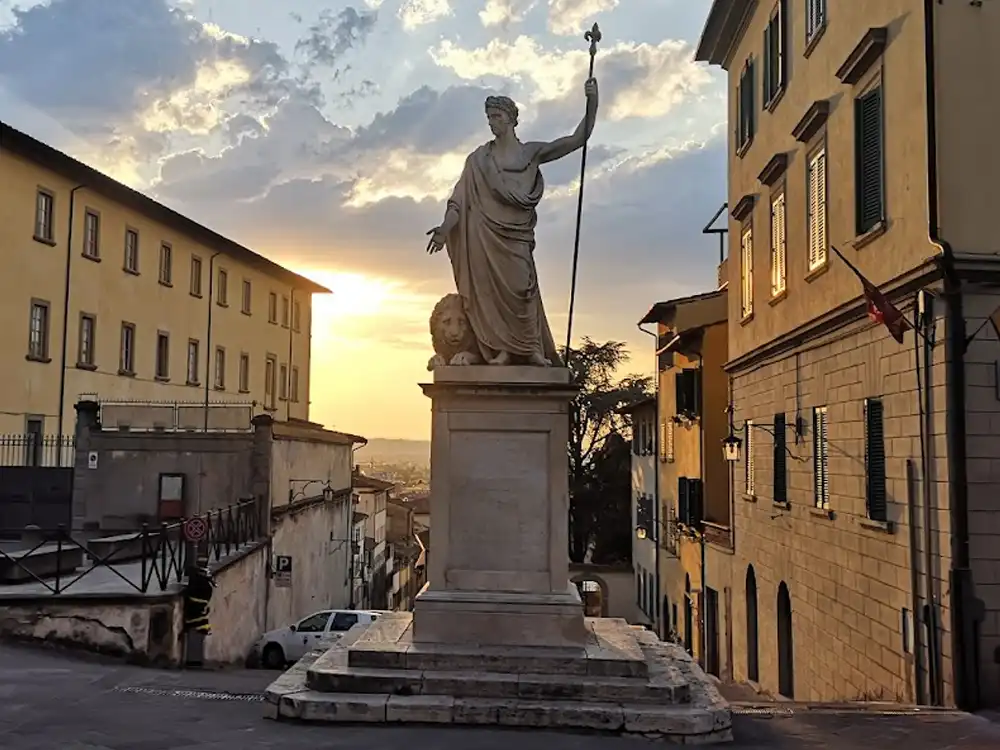
Who was Ferdinand III of Lorena
Ferdinand III of Lorena was the second son of Grand Duke of Tuscany, King of Hungary and Bohemia Peter Leopold II of Habsburg-Lorena. When the latter became Holy Roman Emperor in 1790, it was Ferdinand who took his place as Grand Duke of Tuscany.
He held the title of Grand Duke until 1799 when, despite strong Italian resistance (especially remember the anti-French movement Viva Maria), Napoleon conquered Italy thus forcing Ferdinand III of Lorena to fall back to Vienna.
When Napoleon was defeated in 1814, Ferdinand III of Lorena immediately returned to Tuscany with his old title of Grand Duke. At this stage he shows good sense by enacting a restoration that is entirely mild, and devoid of purges of personnel operating during the French period. Besides this, he leaves in place some of the laws in civil and economic matters. He also seriously carries forward many public works such as, precisely, the reclamation of the Val di Chiana.
The people of Arezzo have never been fond of the Tuscan rulers, but thanks to his efforts to return the precious fertile lands of the Val di Chiana to the people, Ferdinand II is certainly an exception.
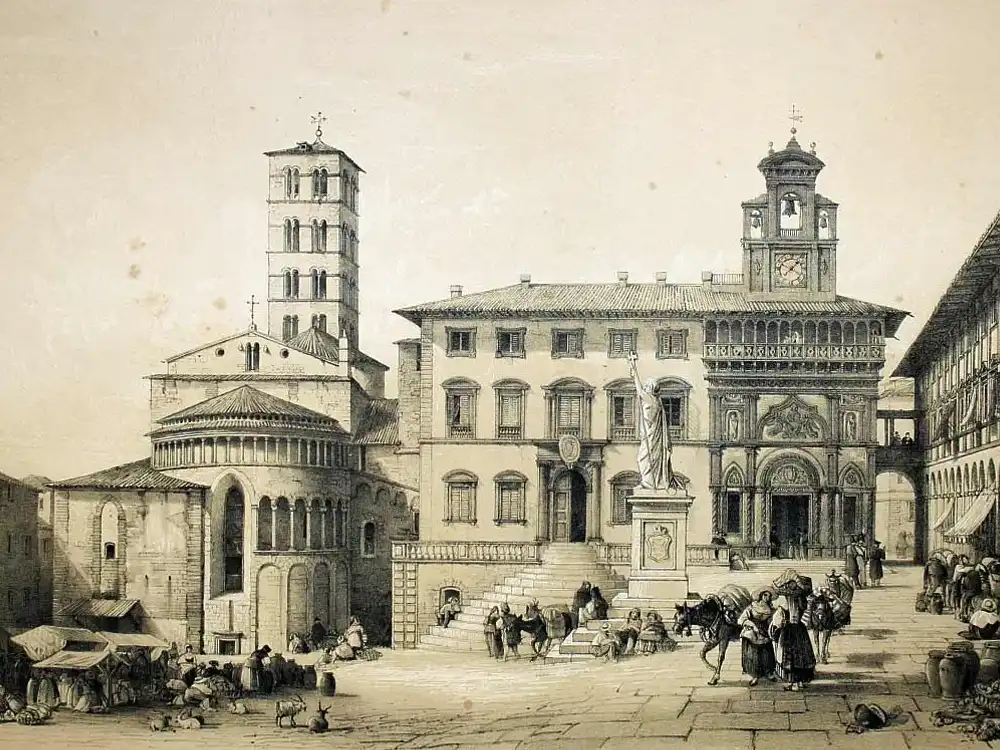
Old Location
The statue, which now stands atop Piaggia di Murello, was actually placed in 1822 in a far more central location: Piazza Grande.
It remained there for a full 110 years, when following a stylistic restoration and to make way for the lizza for the Joust of the Saracen, it was moved to its current location.
Ferdinand III of Lorena : the Statue
The statue was made of Carrara marble on a base of Rapolano travertine by the Florentine artist Stefano Ricci (best known for the cenotaph of Dante Alighieri in Santa Croce).
The Grand Duke is depicted wearing an antique toga and crowned with oak leaves, a symbol of virtue, strength, perseverance, and loyalty. In one hand he holds a scepter, the emblem of power, while at his feet lies a tamed lion. Also of note is the bas-relief on the base called The Union of the Chiana and the Arno. It is probably the work of Arezzo sculptor Ranieri Bartolini and depicts the two rivers as two anthropomorphic figures.
The Chiana as a woman with her back turned looking toward the man, the Arno precisely, who is observing her in turn. This allegory also symbolizes the work of Ferdinand III of Lorena: in fact, it represents the extensive work of the works that affected the valleys of Arezzo and their reclamation.
The Reclamation
Swampy and alluvial soils have always been connected not only to geohydric disasters, but also to significant health problems and risk of malaria due to the very high presence of infected mosquitoes. That is why as early as the 14th century, with the Medici, they had begun to think about extensive reclamation work, which would be finally completed in the 20th century.
Today it is possible for all lovers of greenery, trekking and mountain biking to walk along the Val di Chiana reclamation trail that reaches the Chiusa dei Monaci in Arezzo.
The Statue of Ferdinand III of Lorena and the Antiche Mura B&B
If you stay at the B&B Antiche Mura, you’ll have the privilege of admiring the statue of Ferdinand III of Lorraine every day, right in front of the building. This imposing monument is not only a tribute to Tuscan history, but also a symbol of the deep bond between Arezzo and its grand ducal past. Dressed in a classical toga and wearing a crown of oak leaves, Ferdinand III seems to be watching over the city and its visitors. Observing him at sunset, with the warm light emphasising his details, will add a touch of magic to your stay. A little treasure visible directly from your window, to feel immersed in history as soon as you wake up.