


The Duomo of Arezzo: a Gothic masterpiece in the heart of the city
The Duomo of Arezzo is much more than a cathedral: it is an authentic treasure trove of art and spirituality that dominates the city from its panoramic position. Visiting the Cathedral of Saints Peter and Donatus means taking a journey through time among Gothic architecture, Renaissance frescoes and works of art of immense value. The current church, the result of centuries of construction and alterations, is one of the symbols of Arezzo, loved by both the faithful and history and art enthusiasts.
In addition to the extraordinary beauty of its structure, the cathedral houses treasures by great masters such as Piero della Francesca, Donatello and Guillaume de Marcillat. In this article, we will guide you on a tour of the five works you absolutely must not miss: a short itinerary to appreciate the best of this Tuscan wonder, perfect to combine with a stroll through the historic centre of Arezzo, just a few steps from the B&B Antiche Mura.
The Cathedral of Saints Peter and Donatus: a brief introduction
The Cathedral of Saints Peter and Donatus, known simply as the Duomo of Arezzo, is the spiritual heart of the city and one of its most recognisable symbols. It stands on top of the main hill, on the site of the ancient Etruscan acropolis and, later, an early Christian church. The current building was begun in 1278 at the behest of Bishop Guglielmino degli Ubertini, thanks to a large donation left by Pope Gregory X, who died in Arezzo in 1276.
Construction lasted for centuries, with frequent interruptions, until its final completion in 1511, while the current façade was added between 1901 and 1914. Dedicated to the martyr Saint Donatus, the cathedral houses his relics and continues to be a place of worship and devotion. In addition to its religious value, it bears witness to the history of Arezzo and is a precious repository of Gothic, Renaissance and Neo-Gothic art.
Architecture bearing witness to centuries of Arezzo’s history
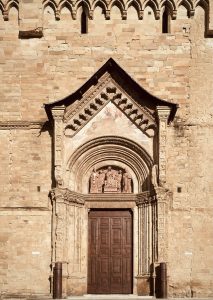
The architecture of the Duomo of Arezzo is the result of a long historical evolution that has left visible traces of different eras. On the outside, the majestic neo-Gothic façade, completed in the early 20th century to a design by Dante Viviani, stands out for the three statues above the central portal and a large rose window that illuminates the nave. The right side retains its original 14th-century appearance, with sandstone blocks and an extraordinary portal decorated with medieval statues and bas-reliefs.
The interior has three naves with cross vaults supported by tall pillars and is striking for its harmony and the light filtered through the polychrome stained glass windows. The apse, with its tall mullioned windows and stained glass windows rebuilt after the war, amplifies the verticality of the sacred space. In every corner of the cathedral, the architecture dialogues with the art, telling the story of a cathedral that has managed to survive the centuries without losing its identity.
The 5 works in Arezzo Cathedral that are not to be missed
The Duomo of Arezzo is not only an architectural masterpiece: it is also a unique art gallery, where centuries of faith, beauty and artistic mastery come together. Among the many works inside the cathedral, some stand out for their historical significance and the aesthetic value they continue to convey to visitors. In this itinerary, we have selected five unmissable masterpieces that represent the soul of the cathedral: painting, sculpture and stained glass intertwine in a visual narrative that excites and enchants.
From the vibrant light of Marcillat’s stained glass windows to the refined expressiveness of Piero della Francesca’s Magdalene, each work is an invitation to stop, observe and be inspired. Whether you are an art lover or simply a curious traveller, these five stops will accompany you on a journey of discovery through the artistic heart of the Cathedral, just a few minutes from your stay at the B&B Antiche Mura.
Piero della Francesca’s Magdalene
Among the most famous works preserved in the Duomo of Arezzo is the extraordinary Magdalene by Piero della Francesca, painted between 1460 and 1466. It is a fresco of rare expressive intensity, depicting the saint in full figure, captured in a composed and dignified pose as she looks out from a decorated archway. Piero, a master of light and perspective, succeeds here in infusing the figure with a sober but deeply human elegance, thanks to his skilful use of chiaroscuro and an innovative plastic realism.
Mary Magdalene seems to emerge from the architectural space, creating a strong sense of presence. This fresco is located in the left aisle, next to the cenotaph of Bishop Guido Tarlati, and represents one of the artistic peaks of the Italian Renaissance. Admiring it up close is a unique opportunity to come into direct contact with the genius of one of the greatest painters of the 15th century.
The Baptism of Christ attributed to Donatello
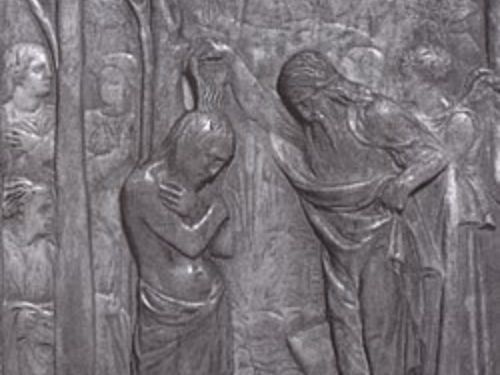
In the left aisle of the Duomo of Arezzo, inside the hexagonal baptistery, is one of the most fascinating reliefs in the cathedral: the Baptism of Christ, attributed to Donatello and his workshop, created around 1430. The work, carved in marble, is striking for the extraordinary expressiveness of the faces, the softness of the lines and the sense of depth that anticipates the full Renaissance.
The scene depicts Jesus in the centre, immersed in the waters of the Jordan, receiving baptism from St John the Baptist. On either side, angels and spectators lend balance and rhythm to the composition. The attribution to Donatello is supported by stylistic similarities with other contemporary works, but the side reliefs, depicting episodes from the life of Saint Donatus, also show the influence of artists such as Francesco di Simone Ferrucci. This is a highly refined work that enriches the artistic itinerary inside the cathedral and bears witness to the Florentine sculptural heritage.
The stained glass windows of the Duomo of Arezzo by Guillaume de Marcillat
One of the most fascinating elements of the Duomo of Arezzo is the intense play of light generated by the splendid polychrome stained glass windows by Guillaume de Marcillat, created between 1516 and 1524. This French master, who was active in Italy during the Renaissance, brought to Arezzo a refined technique and a taste for storytelling that is expressed in biblical scenes rich in colour and movement.
Among the most famous are the Pentecost, in the large rose window on the façade, and scenes from the Baptism of Christ, the Calling of Saint Matthew and the‘647’>Baptism of Christ, the Vocation of Saint Matthew and the Resurrection of Lazarus, distributed along the aisles. Each window tells a story, each detail an explosion of light and faith. Its stained glass windows not only enrich the cathedral with extraordinary beauty, but transform natural light into a spiritual experience. Admiring them is like entering a sacred story filtered through the colour and skill of a timeless artist.
The Ark of San Donato
In the heart of the apse of Duomo of Arezzo is one of its oldest and most symbolic treasures: the magnificent Ark of San Donato, patron saint of the city. Made of marble between the mid- and late 14th century, it is a Gothic masterpiece sculpted by craftsmen from Siena, Florence and Arezzo. The urn is supported by twelve columns decorated with spires and pinnacles, and depicts in bas-relief the life of the saint, bishop and martyr, whose body is kept inside (his head is in the Pieve di Arezzo).
The work is composed of several decorative bands: the lower one, attributed to Agostino di Giovanni and Agnolo di Ventura, and the upper one, with a marble altarpiece depicting the Madonna and Child, signed by Giovanni di Francesco and Betto di Francesco.
The Ark is not only a funerary monument, but also an altar around which the centuries-old devotion of the people of Arezzo is gathered.
The Funerary Monument of Pope Gregory X
One of the most evocative elements of Arezzo Cathedral is the funeral monument of Pope Gregory X, located in the right aisle. The pontiff died in Arezzo in 1276 on his way back from the Council of Lyon, leaving the city the funds to build the new cathedral. His Gothic tomb dates back to the early 14th century and consists of an ogival canopy resting on columns of different marbles, under which lies the sculpted figure of the pope.
The sarcophagus is decorated with bas-reliefs depicting Christian symbols, the Evangelists and sacred scenes, while the blessing Christ appears at the top of the canopy. The overall effect is solemn but harmonious, testifying to the city’s gratitude towards the pontiff. A close look at the sculptural details reveals the skill of the Tuscan artists of the time and the strong
Discover the art of the Duomo of Arezzo by staying at the B&B Antiche Mura
Visiting the Cathedral of Arezzo is an experience that combines wonder, spirituality and beauty: every corner of the cathedral tells centuries of history and houses timeless artistic treasures. To immerse yourself completely in this unique atmosphere, there is nothing better than B&B Antiche Mura, located in the heart of the historic centre, just a few steps from the cathedral.
Our property is the ideal starting point for exploring not only the cathedral, but also the squares, museums, artisan workshops and medieval views that make Arezzo an unforgettable city.
After a day spent enjoying art and history, you can relax in our cosy, well-appointed rooms and breathe in the authentic atmosphere of Tuscany.