


Santa Maria delle Grazie shrine: from pagan origins to Christian sanctuary
Santa Maria delle Grazie has its roots in antiquity, when the site was home to a sacred spring dedicated to the god Apollo, a symbol of healing and light. During Etruscan and Roman times, this place attracted worshippers for rituals related to the therapeutic properties of water. In time, the spring remained a landmark for the community, taking the name Fons Tecta in the early Middle Ages. The pagan traditions, however, came into conflict with Christianity, which attempted to transform the significance of the place. This transition was marked by the arrival of St. Bernardine of Siena in the 15th century, beginning a new era that would lead to the birth of the shrine as we know it today.
The destruction of the pagan spring and the birth of the oratory
In 1425, St. Bernardine of Siena attempted to eliminate the pagan rites associated with the Fonte Tecta, a spring venerated for its alleged healing properties. However, he encountered strong opposition from some local noble families and was forced to give up. He returned in 1428 with the support of numerous believers and succeeded in destroying the pagan spring. In its place he had an oratory built as a symbol of the victory of the Christian faith.
In 1430, Parri di Spinello painted in the oratory the fresco of “Our Lady of Mercy,” depicting the Virgin protecting the people under her mantle. This new sacred representation transformed the place into an important center of devotion for the people of Arezzo and beyond.
The construction of Santa Maria delle Grazie and the Renaissance artistic legacy
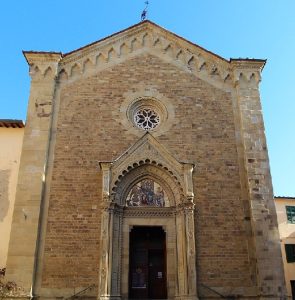
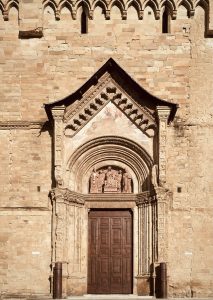
As a result of the growing influx of worshippers, the oratory soon proved insufficient, leading to the construction of a new church between 1435 and 1444. Designed by Domenico del Fattore, the building reflects the late Gothic style with a single nave and cross vaults. On the right side of the church between 1450 and 1456, a chapel dedicated to St. Bernardine, canonized in 1450, was added.
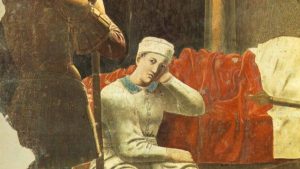
This phase of construction marks the transition to the Renaissance, with architectural elements introducing a new artistic language. The interior of the church houses works of great value, such as the frescoes by Lorentino d’Andrea, which reveal the influence of the master Piero della Francesca, giving the sanctuary a unique artistic identity in the Arezzo area.
Benedetto da Maiano’s loggia: a Renaissance masterpiece
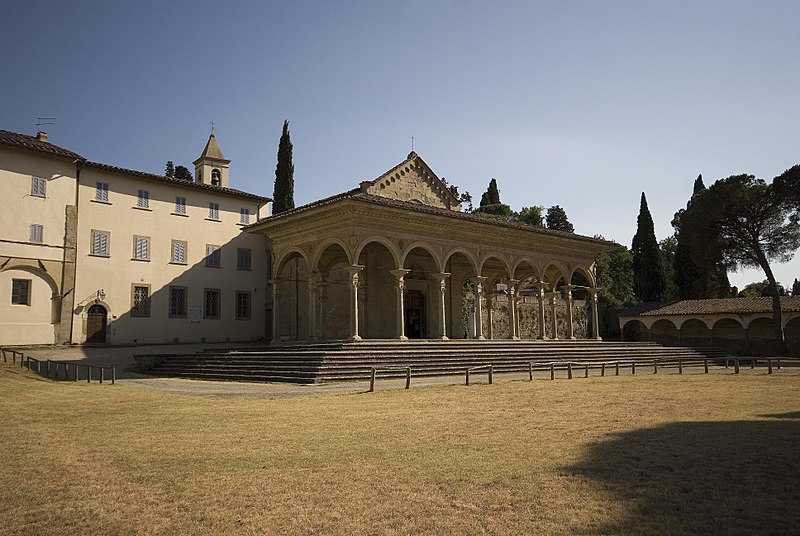
Between 1477 and 1490, the sanctuary of Santa Maria delle Grazie was enriched by an extraordinary Renaissance loggia designed by Benedetto da Maiano. This work, which elegantly frames the facade of the church, consists of fifteen arches supported by slender Corinthian columns. The structural lightness, with the supremacy of voids over solids, gives the loggia an aura of harmony and refinement that impressed even Gabriele D’Annunzio, who described it as an “aerial loggia.”
Inspired by the proportions of Brunelleschi’s Ospedale degli Innocenti, the portico represents one of the highest examples of Renaissance architecture. This structure, a symbol of elegance and innovation, further enhances the entrance to the sanctuary, making it an architectural and artistic jewel of Arezzo.
The marble altar by Andrea della Robbia at Santa Maria delle Grazie
The interior of the church holds one of the masterpieces of the Tuscan Renaissance: the marble altar by Andrea della Robbia, created between 1487 and 1493 with the collaboration of his sons. Designed to house Parri di Spinello’s “Madonna of Mercy” fresco, the altar is a work rich in detail and symbolism. Statues of St. Donato, St. Bernardino and the martyrs Lorentino and Pergentino stand out in the center, while the tympanum is adorned with a Madonna and Child between angels.
The work is embellished with candle-bearing putti, cherub heads and a festoon of fruit in polychrome glazed terracotta. Alongside this marvel are frescoes by Lorentino d’Andrea, inspired by Pierfrancesque culture, which complete the sanctuary’s artistic experience.
A visit through the centuries: history and memory
Santa Maria delle Grazie has spanned the centuries while keeping its spiritual and historical relevance intact. In 1695, the Discalced Carmelites took over the shrine, but the complex was subject to various vicissitudes: grand ducal suppressions, Napoleonic expropriations and the risk of demolition. It was only thanks to the interest of the Aretine community and the return of the Carmelites that the shrine was able to preserve its value.
Over time, some works have been transferred to Arezzo’s Museum of Medieval and Modern Art, but the shrine remains a living place of art, with its architectural structure, Renaissance portico and frescoes evoking a profound connection between art, faith and historical memory. An unmissable journey through time.
Antiche Mura: the ideal starting point for exploring Arezzo
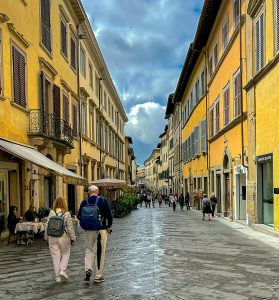
Located in the heart of the historic center, B&B Antiche Mura is a perfect base for discovering the wonders of Arezzo, including Santa Maria delle Grazie. The strategic location of our B&B in downtown Arezzo makes it easy to reach this splendid shrine, along with other artistic and historical attractions in the city. After a day of sightseeing, guests can relax in a cozy and authentic environment, enjoying comfortable rooms and a family atmosphere.
Choosing Antiche Mura means a unique experience, combining the convenience of staying downtown with the opportunity to immerse yourself in the cultural and spiritual richness of Arezzo. Booking a stay here is the first step to exploring the beauty of the city and its surroundings with simplicity and style.